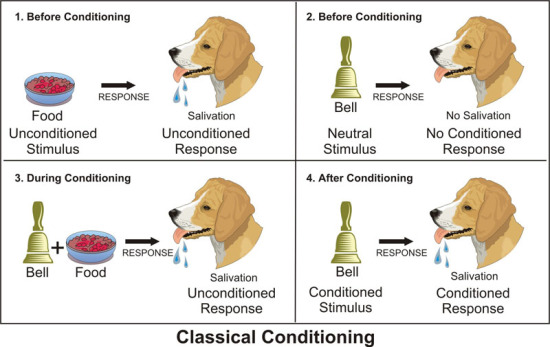
 This idea of classical conditioning actually came about accidentally. Ivan Pavlov discovered this way of learning in 1927 when working with dogs to further his research on the digestive system. In this experiment Pavlov placed a dog in a harness so that he could measure their salivation when presented with food. The accidental discovery of classical conditioning came when the dogs began salivating even at the sight or sound of the lab assistant bringing in the food. Essentially classical conditioning occurs when we begin to associate an object, sight, or sound with a specific sensation. This is a learned or remembered pattern that we develop over time or through repetition. In the case of Pavlov's experiment with the dogs, the dogs developed the inherent knowing of the food coming by the repetition of the lab assistant bringing them the food.
I found this specific experiment to be especially interesting, because it shows just how adaptable human beings are especially when it comes to the ideas of learning. When it comes to learning we draw from the experiences we have. Much like the dogs in Pavlov's experiments we learn by association and recurring situations or examples.
 A specific real world example of classical conditioning could the idea of police officers. They are conditioned and trained to react to the sights, sounds, and environment around them. Another example could be the idea of a basketball player. Most of the time a person who does not or has not played basketball would not react to a ball abruptly being thrown at them in the same manner that a basketball player would. Through classical conditioning a basketball player would automatically put up their hands and catch the ball or try to catch it where as someone who has not been in sports might duck or try and get away from the ball.
Sources:
Chapter 6 PDF on learning

No comments:
Post a Comment