Sunday, May 6, 2018

Final Learning Reflection


Related image         Alright, so this will more than likely be my final blog. So, to bring this whole blogging thing to a close I'm going to do an overview of the things that I learned during my time in Intro to Psychology and I am also going to be talking about the things and ideas that impacted me the most.
         First, I am just going to give ya'll a bit of an overview of all the topics that we discussed throughout the semester. The first topics that we discussed were covered in Module 1: Getting to Know Me, YOU, and Psychology. In this module we learned the basics of blogging and then we later learned about the many sub-fields of Psychology. Overall, this was definitely a learning experience for me because I had never done anything like this before, but it turned out to be pretty fun overall. Next came Module 2: Brain, Sensation, and Perception. In this module we learned all about the different parts of the brain and how they play into psychology and the things you do. This module wasn't really the easiest for me to comprehend, but eventually I understood it thanks to Emelia's blog on the subject. While we are on the subject of helpful blogs, there were two people's blogs who I found to help me from week to week. Emelia's being one of those, but Aylin's also helped me to better understand the material as we went through this class. Continuing on, the next topics we covered were Development Psychology and personality in Module 3. This module had by far my favorite experiential task. Since we learned about personality in this module, we were given the opportunity to do a character study on someone. The instructions for this task were that we needed to analyze the personality of someone over time period, age, different situations, and contexts. At the end of this "interview" we were supposed to make an educated guess of what type of personality they would have if they took a personality test. For this task I decided to analyze my mom's personality, which is probably why I enjoyed this task so
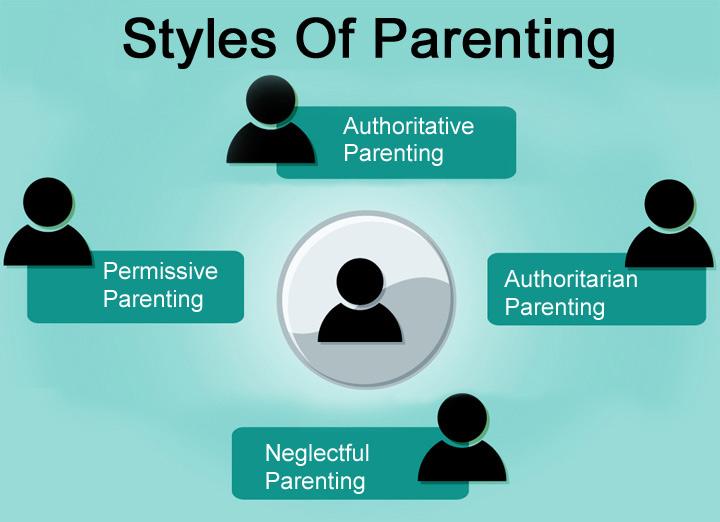
much. I say that because my mom has a very eccentric personality. She unapologetically doesn't care what anyone thinks of her and she is totally not afraid to speak her mind, so it was interesting to see how her past and childhood reared this great personality. While we are still on the topic of Developmental Psychology. In terms of comments, Austin's comment on my Developmental Psychology post really stood out to me, because I thought my parents parenting style was kind of atypical so it was cool to find out that his parents had a similar style. Next came Module 4, of course. This module was all about learning and memory. We talked about the different theories of learning and also got to see a really cool experiment with a dog that led to some of these different theories. When we talked about memory, we learned that there are five theories of forgetting which are: decay, interference, motivated forgetting, encoding failure, and retrieval failure. I found all of these theories to be really interesting and I even think that knowing about them could potentially help me in studying for future tests. As you can probably already guess, after Module 4 comes Module 5 in which we learned all about motivations, emotions, and social psychology. This module also happens to be one of my favorites from the ones that we did this semester. I really enjoyed studying social psychology, because it helped me fully realize just how judgmental of a society we are. I also happened to do my student-led activity on this subject which I really enjoyed, because my partner and I got to show the class just how many "social norms" we have and do not even realize. Of all the modules though, I think knowing about Social Psychology will be most helpful in my future career because I want to be a plastic surgeon. Often times social psychology plays a big role in this field of medicine, so ultimately, I think I will be better equipped and able to know when my patients really want a surgery for themselves, or just because they think people will like them better. Module 6 was next on our learning list in the semester, so we learned about Psychological disorders and therapy. I also really enjoyed this module, because my family has a long history of psychological disorders, so it was very helpful to learn about the different symptoms and also to read the interview blogs about how people with these disorders felt on a day to day basis. During this week we watched a video in class that was really helpful to me in understanding anxiety disorders and panic attacks specifically. This information and understanding has proven to be useful in my personal life, because many of my family members suffer from panic attacks, including my mom and aunt. I got to write probably one of my favorite blogs about them and their journey of dealing with panic attacks during this week. This was one of my favorites because I learned a lot about my family’s history of this disorder that I did not know before. I also got to encourage my classmates to have similar discussions with their own families about their family history of mental health, which I enjoyed having the opportunity to do. So now, we have come to our very last module, which is Module 7. In this module we learned about Positive Psychology. Before this module I did not even know that there was an area of psychology that exclusively dealt with the study of human flourishing and putting these ideas into action, so I learned a ton in this module. In this module we got to write notes of gratitude, hold the door open for people, hand out candy, and we even got to play a few fun games to learn about communication. I enjoyed all of these things, because like we learned, it has been scientifically proven that doing nice things for others can make you be happier and even live longer, which is always a good thing. The ideas that we went over about communicating is also another idea that could be helpful to me during my future career. I say this because you want to make sure you are communicating your ideas well when you are about to cut someone open and change their physical appearance. Overall, when it came to class times I really enjoyed the last class that we had the most, because we got to hear everyone's opinions and we got to talk about our favorite topics from the class. In terms of learning overall throughout the entire course the various ted talks that we were assigned to watch were very big in helping me understand the topics that we were covering from week to week. I really enjoyed watching the one about how the brain benefits from sleep because people my age tend not to get a lot of sleep so it was interesting to learn about what exactly that does to the brain. I enjoyed this one so much that a majority of one of my blogs was written about it. Overall, This class was a very good learning experience and I enjoyed getting to read everyone's blogs and learn more about them from week to week. 

Sunday, April 29, 2018

M7 Task


This week’s module was all about Positive Psychology. Positive Psychology is the is scientific study of human flourishing, and an applied approach to optimal functioning. With This week’s task having to do with this concept, we were supposed two do one planned thing that we enjoyed and then another planned thing that would help bring someone else happiness or just help them in general. So, for this week’s task I decided early on in the week that I was going to make a trip home this weekend. I mainly decided to do this so that I could complete the “philanthropic” part of my task because one of my close friends who also goes to HSU said that she was going home this weekend, but I also decided to change up my “pleasure” task from having a lake day to having a nice pool/ outside day so that I could really have some time to have fun and attempt to become less stressed before finals week came around.
For my “philanthropic” task I decided that I was going to surprise one of my close friends Friday night when I got back to Dallas and take her to dinner. She has been telling me lately how stressed out she has been due to college and her busy schedule in general, so I thought that it would be a good stress reliever for her to just get out for a while and have dinner and to talk. Although my friend knew we were going to dinner, she did not know that I was going to end up paying for her at the end. So, I ended up paying for her dinner and everything and she was really surprised because my friends and I do not really like anyone paying for us ever, so she did not expect for me to do that. At the end of it all she was really happy and said that it made her feel appreciated and slightly less stressed because we were able to talk a lot. She also said that it was fun to be able to spend time with each other because we both are always really busy and do not get to hang out as much because we always happen to not be in Abilene at the same time due to her track schedule and me being busy this semester with having to go home a lot for family events like weddings and such.
For the “pleasure” part of this task, as I mentioned before I decided pretty early on in the week that I was going home, so I decided to specifically set aside about three to four hours of just hanging out outside and swimming a little bit. I decided to do this task because I love being by the water and being outside. I have always found both of these things to being very calming and stress relieving for me, so I thought it would be good to do since finals week is fast approaching and this semester has been kind of difficult for me.
Even though I enjoyed doing both tasks that I completed this week, there were definitely some differences that I could tell between the two. For the “philanthropic” task, although I enjoyed having dinner with my friend and trying to help her feel better, I had just sat in traffic and driven for three hours so I was really tired, and it took a lot of energy for me to want to get up from my bed and drive back to Arlington to eat with her. It also required me to save my money a little bit, because I mean I am a broke college kid just like everyone else. LOL The down side of my “pleasure” task was that it required me to think ahead enough and actually plan out my Saturday, which I usually do not like doing because I do not like to plan that far ahead usually. The similarities between these two tasks would be the fact that I enjoyed both of them. When it came to the “philanthropic” task I enjoy helping people in general, which is why I want to be plastic surgeon eventually, so it really wasn’t all that hard for me to want to try to help someone feel better no matter the person. I have always been involved in community service projects, even though I wouldn’t say I did any community service for this task, so I just naturally have a want to help people in any way that I can. Obviously, I also enjoyed my “pleasure” activity because I got to do something that I really enjoy doing even though it took some slight planning. I think that just this task in itself will be helpful to me in the future, because I learned that I need to set aside more time for doing things that I enjoy and that relieve stress for me. Overall, this task and module was really helpful to me in terms of getting me to think a little more about showing gratitude for others and doing things that I enjoy more often.

Sunday, April 15, 2018

M6 Task

         For this week's experiential task I decided to interview two people that are very close to me. That would be my mom and her sister. My mom and her sister both share an anxiety disorder which is commonly known as panic attacks
Image result for panic attacks         According to them they both discovered that they had panic attacks around the same time as each other. My aunt noticed that she was having problems with panic attacks about a year before my mom did. My mom was quick to mention that these panic attacks showed up for both of them around the time that their mother, my grandma, was diagnosed with kidney cancer. When my mom started having panic attacks they had just found out that their mother's cancer was terminal. My mom said she had no idea what was happening when she had her first one because she had never heard about them before. Although, my aunt had already discovered she was having them she did not tell anyone in the family so this is partially why my mom was still not familiar with them. 
         When my aunt experienced her first panic attack she immediately went to the doctor and the doctor was able to prescribe her with an antidepressant and an anti-anxiety medication, which she still takes to this day. However, my mom's anxiety attacks were not as easily fixed so she had to go from her regular MD to a psychiatrist who then prescribed her with a strong antidepressant and anti anxiety drug because "she couldn't even sleep at night." My mom said it was especially difficult for her because she had to go through a trial and error period of testing medications, which my aunt mentioned she did not have to do. 
         Both my mom and aunt said that they have a great quality of life now, living with this disorder. Both of them work about sixty hours a week in a "high stress environment" and have not suffered with any panic attacks since being put on their medications. When I asked them about who in their lives helped them to get through the rough times of having these panic attacks they both said that family helped them tremendously. For my aunt she said her daughter helped her get through it the most and my mom said that her whole family was crucial during this time.
         Through this project I learned a lot about my aunt that I did not know. I also learned that through this both my mom and aunt were able to have a conversation with their mother about this and they discovered that anxiety disorder runs in their family. I, myself, did not know this before this project so it was very intriguing to learn that about my family. I did record this interview, but it was just a screen recording from face time, so I do not really have any pictures or videos to add this time, but I hope that you enjoyed this blog nonetheless. I also encourage you to talk with your own family about any mental disorders or any illnesses in general that your family might have a history of because, it might be helpful for you to know in the future. (Below I have attached a link to a video that takes you through what it is like to go through a panic attack, feel free to watch it or not if you are wanting to know a little bit more about panic attacks.)
What a panic attack feels like.

Sunday, April 1, 2018

Arnold's Story


            This week I decided to interview my friend's roommate Arnold. Arnold is quite an interesting individual and has a really amazing story and background so I thought he would be a great person to interview about multiculturalism. As you will find out from the video Arnold is a foreign exchange student at ACU. His family currently lives in Dubai, but he has lived in many different countries throughout his life. There are many challenges that international students face such as "fitting in" to a new culture, finding new friends, adjusting to new classes and teachers who may teach differently or speak a new language, but the most difficult of these challenges would be "fitting in" as Arnold explains in the video. When you are not easily accepted into a new culture most of the time you employ coping skills in order to get through this tough time. Some of these coping skills might include using drugs or alcohol to try and forget about the issues you are facing or completely secluding yourself and cutting the people who do accept you completely off. I say that drugs or alcohol can be used a s a coping mechanism because although Arnold did not share it in the video he did share with me that he once had a drug and alcohol problem. He has since overcome this issue, but he did mention that it was a big problem for him at one time. Later I asked Arnold about a coping mechanism that he uses now and he said in order to make him feel better about not being at home he constantly surrounds himself with friends. This is a positive coping mechanism that he has used. In Arnold's case he adapted to not '"fitting in" by deciding that he just didn't care what people thought of him anymore. In my opinion this choice has made him into a very extraordinary and caring individual. Arnold has been placed in and experienced many different cultures around the world and he himself is also a mixture of many cultures, but throughout his life he has always tried to embrace and learn in whatever culture he has been placed in. Arnold has been through a considerable amount for being only twenty, yet he has taken it all in stride and become a very driven and joyful individual. I hope through Arnold's story you can see that no matter what circumstances are placed in front of you, you can achieve whatever you set your mind to just like he has and continues to do. #PsychStory

Monday, March 12, 2018

Memory

Image result for memory
              There are three ways that memory can be viewed: as types, stages, or as processes. There are two types of memory that can be looked at; explicit and implicit. Explicit memory deals with knowledge or experiences that can be consciously remembered. Although implicit memory deals 
with experience as well, it deals with experience as it influences behavior, even when these changes or experiences are not easily pinpointed. 
              The second way that memory can be viewed is as stages. Memory has three stages: sensory, short- term, and long- term. You are probably most familiar with viewing memory in this way. Sensory memory acts as a sort of "memory buffer" so if your brain determines that the information that you have received is not useful then it is not remembered. Short- term memory is the area that usually keeps small bits of information for more than a few seconds, but less than a minute. Long- term memory usually holds your most important memories, such as names or materials that you have studied for a test. 
              The third and final way that we can view memory is as processes. The first process, encoding, " is the process by which we place experiential things into our memories." Information cannot be properly remembered without this step.The second, storage, does exactly what it sounds like, it stores the memories that you obtain overtime. The final process, retrieval, is when your brain "retrieves" memories or information when it is needed.
Image result for clive wearing              The part that stood out most to me from the videos and readings this week was the video about Clive Wearing. Clive has a very strong case of amnesia that is so severe that he cannot even remember something from thirty seconds ago. In the video Clive went on having a normal conversation with his wife, but what he did not notice was that his wife was essentially repeating the same things over to him. Usually a close family member in that position might become frustrated or upset because of the situation that their loved one has been put in, but I thought that it was really cool that his wife was very upbeat and positive when talking about Clive's situation even though the situation is definitely not the best. As we can see from Clive's case memory is a very important part of our daily lives that we too often take for granted and we should all try to be more thankful for the amazing gift of memory that God has given us.

Sources:
Chapter 8: Memory PDF
https://www.youtube.com/watch?v=Vwigmktix2Y 

#M4ExpTask

False Memory and the Serial- Position Effect: https://www.youtube.com/watch?v=U_c7nIuL1g4 

Monday, March 5, 2018

Learning

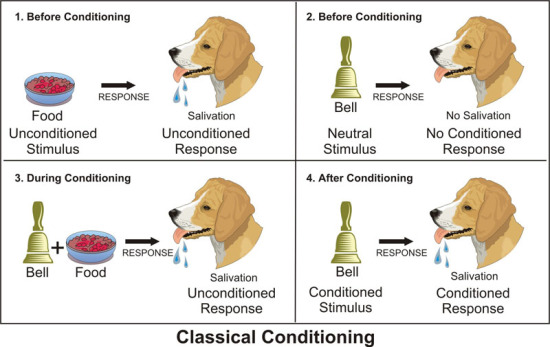
            According to chapter 6 learning is the process that occurs when life experiences change our behavior or thinking. There are an abundance of examples in everyday life that show that this statement is true.There are three main areas of learning classical conditioning, operant conditioning, and observational learning, but today I will just be focusing on classical conditioning. 
Image result for pavlov's dog experiment            This idea of classical conditioning actually came about accidentally. Ivan Pavlov discovered this way of learning in 1927 when working with dogs to further his research on the digestive system. In this experiment Pavlov placed a dog in a harness so that he could measure their salivation when presented with food. The accidental discovery of classical conditioning came when the dogs began salivating even at the sight or sound of the lab assistant bringing in the food. Essentially classical conditioning occurs when we begin to associate an object, sight, or sound with a specific sensation. This is a learned or remembered pattern that we develop over time or through repetition. In the case of Pavlov's experiment with the dogs, the dogs developed the inherent knowing of the food coming by the repetition of the lab assistant bringing them the food.
            I found this specific experiment to be especially interesting, because it shows just how adaptable human beings are especially when it comes to the ideas of learning. When it comes to learning we draw from the experiences we have. Much like the dogs in Pavlov's experiments we learn by association and recurring situations or examples.
Image result for basketball thrown             A specific real world example of classical conditioning could the idea of police officers. They are conditioned and trained to react to the sights, sounds, and environment around them. Another example could be the idea of a basketball player. Most of the time a person who does not or has not played basketball would not react to a ball abruptly being thrown at them in the same manner that a basketball player would. Through classical conditioning a basketball player would automatically put up their hands and catch the ball or try to catch it where as someone who has not been in sports might duck or try and get away from the ball.


Sources:
Chapter 6 PDF on learning

Monday, February 26, 2018

Character Study

             For this assignment I decided to do a character study on my mom. My mom is a very likable and inclusive person. She never really leaves anyone out and is always thinking of others. Although this true, she is also extremely blunt and truthful, there is absolutely no sugar- coating things when it comes to her. Because of these reasons I thought she would be a very interesting person to do a character study on.
             When I asked my mom where she thought her main personality traits came from she said that she believed they came from her dad. She said this because much like her, he was very orderly, commanding, and blunt. Which she believes are three of her most prominent personality traits. The main thing that she admired about her dad was the affect that he had on others. He always drew and audience to himself no matter what he was doing or saying. My mom also said that she was actually "fascinated" by this aspect of her dads personality. 
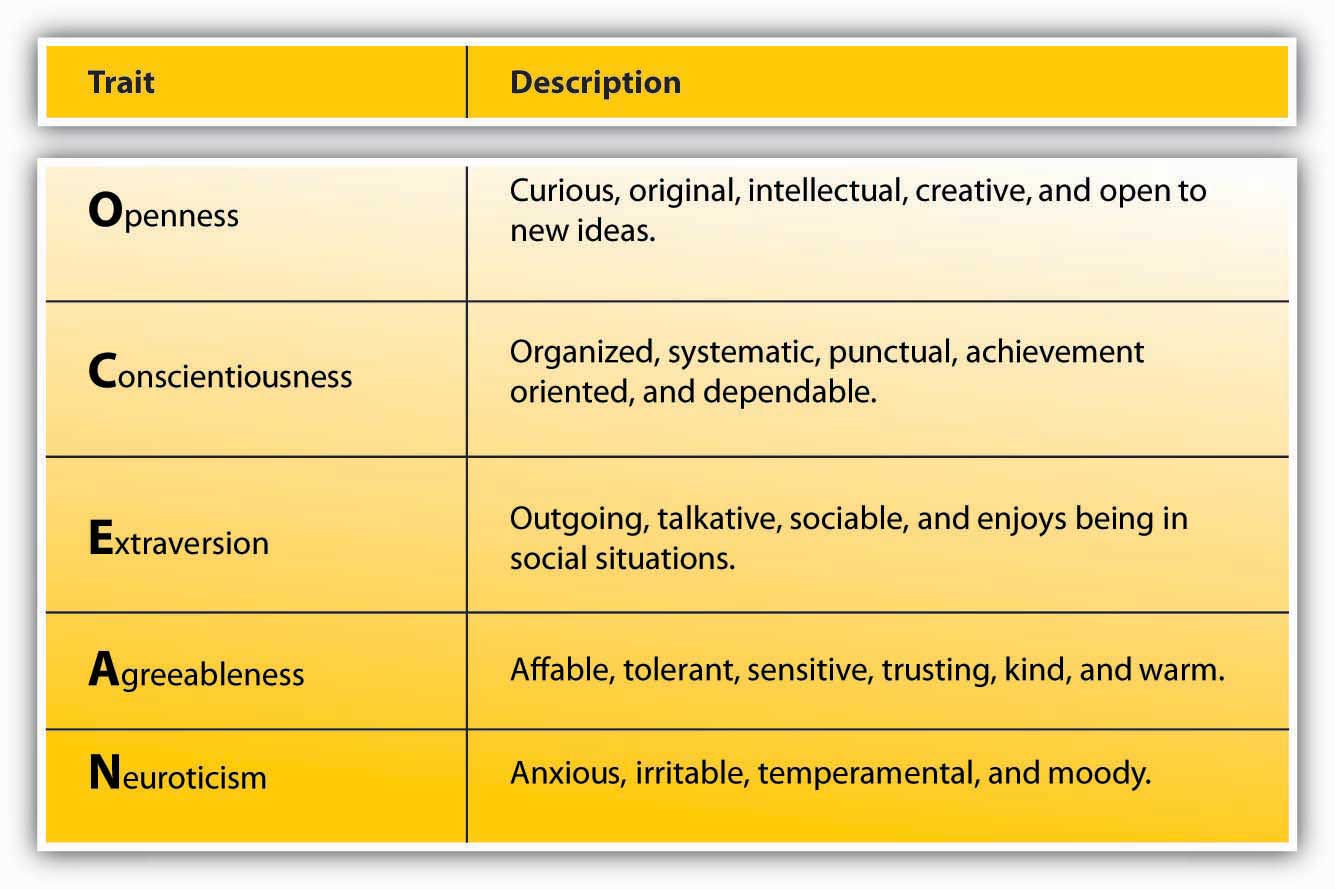
Image result for big five personality test overview              In terms of my mom's personality according to personality tests I would guess based on the big five test that when it comes to extroversion she is as close to one hundred percent extroverted as possible. I say this because throughout my life I have witnessed her profound ability to talk to and make comfortable literally anyone she comes across no matter the situation. In terms of openness I would give my mom a higher score, because she is one of the most creative people I know. On the scale of conscientiousness I would again give my mom a higher score because she is extremely organized almost to a point of insanity and she is also extremely hard- working to a point where she will fully exhaust herself by working to benefit others. When it comes to my mom on the scale of agreeableness I would give her a very middle range score, because she is extremely blunt and honest but also very good- natured at the same time. She doesn't sugar- coat things, but she also cares about how her words effect others. Lastly, when it comes to neuroticism I would give my mom an extremely low score, because much like myself she is very go with the flow. As she put it "some things just aren't worth the hassle"
               Although it was not a new concept to me that my mom's personality was very similar to my grandpa's it was odd to me that she actually admitted that fact. I say this because every time someone brings up that she's acting like her dad she gets irritated and denies it. Overall, this character study was very interesting and helped me learn a few new things about my mom and her about herself.

Sources:
https://hsutx.instructure.com/courses/3078/files/176332/download?wrap=1

Personality Psychology

Image result for personality              If you look around you it is very clear that there is an abundance of differing personalities in the world. These personalities are very unique and not one personality is exactly the same. Because of this, personality assessments are used in all areas of life to help us have the ability to know how our minds habitually work and how we can best work with and serve others.
              The personality test that I chose to use for this assignment is called The Big Five. This test has five basic ideas that it tests for, hence the name The Big Five. Extroversion, agreeableness, openness, conscientiousness, and neuroticism or most commonly know as emotional stability are the five major aspects of your personality that this test focuses on. The big five is accepted by an abundance of personality psychologists, because they believe that it captures the most important differences amongst personalities.
Image result for personality              The test that I took on similar minds gave me 44% extroversion, 66% orderliness, 82% emotional stability, 58% accommodation, and 36% inquisitiveness. Since I have taken other personality tests pretty recently for another class I can see that this is pretty accurate for my personality as far as tests go. I also believe it is pretty accurate for my personality in general all across the board. Overall, according to the tests that I have taken I would say that I am a very even kill person and as most people would describe me very "go with the flow."

Sources:
http://www.oxfordbibliographies.com/view/document/obo-9780199828340/obo-9780199828340-0120.xml 
http://similarminds.com/bigfive.html

Monday, February 19, 2018

Developmental Psychology

             According to simply psychology developmental psychology is the study of growth, change and consistency throughout the lifespan. Many studies in recent years have proven that our parents as individuals and their parenting styles can have either good or bad effects in our later lives after we have gone through adolescence. In this post I will be discussing some questions pertaining to my own parents and how I believe there style of parenting has played a part in shaping me to be the person that I am today.
    Image result for family
  • Reflect on the way you were raised. Consider the parenting behaviors (e.g., rules, discipline strategies, warmth, and support) used in your household when you were a child. Why do you think your parents behaved this way? How do these factors fit with the influences on parenting described here? Provide specific examples of multiple influences on parenting.
    • I was raised in a very honest home. My parents literally never hid anything from me and my sister no matter what it was. Although my parents were very blunt when it came to all aspects of life, they were also very loving and caring at the same time. I never really got into a lot of trouble as a kid so I personally never really experienced the full extent of my parents discipline strategies, but I got to see their strategies with my older sister a lot. I think this is partially the reason why I have never really gotten into any extreme amounts of trouble before. Because of this fact I think my parents felt like they could be more lenient and easy going when it came to the rules they gave me. This also plays into the fact that both of my parents are pretty easy going individuals, at least until you mess up several times. I also believe my parents were this way because that is exactly how their parents were with them, so it was really all just kind of second nature to them.
  • What type of parent do you envision yourself becoming? If you are a parent, how do you parent your child/children? How do you think this is similar to or different than the way you were raised? What influences exist in your life that will make you parent differently from your own parents? 
    • Image result for parenting
    • I envision myself being the type of parent that is very approachable and listens to their children very well. I also hope to be like my parents in the aspect of how well they juggled being successful and busy in their fields of work, but also being very present in the lives of their children. This style of parenting overall is very similar to the ones my parents used in parenting me, because throughout my entire life my parents have always made sure that my sister and I could come to them with anything that we needed to talk about no matter what it is. I think the fact that I have known for a very long time what I want to do in my life sets me apart from my parents since there life was not as planned out as mine is at this point and as a result of this fact I believe that I will be better equipped with more favorable circumstances that my parents did not have before they had children.
  • What kind of relationship did you have with your parents or primary caregivers when you were young? Do you think that had any bearing on the way you related to others (e.g., friends, relationship partners) as you grew older?
    • At the beginning of my life I was very attached to my mother, and according to my dad did not really want to have a lot to do with him Overall though I believe that I eventually warmed up to my dad more and I do not think this had any bad effects or effects in general on the way I relate to others as I have grown older. I say this because for pretty much my whole life I have preferred to a lot of guy friends, because of the less drama associated with guys.
  • Some people, despite reporting insecure relationships with their parents, report secure, well-functioning relationships with their spouses. What kinds of experiences do you think might enable someone to develop a secure relationship with their partners despite having an insecure relationship with other central figures in their lives?
    • I believe that people who do not have secure relationships with their parents can have a secure relationship with their spouse, because when it comes down to it technically your parents and who you decide to have a relationship with are not the same person. I also believe that the more real life experiences you have with your significant other strengthens your relationship, because it makes you better equipped and helps you grow together.

Sources: 
https://www.simplypsychology.org/developmental-psychology.html 
http://nobaproject.com/modules/the-developing-parent#content 
http://nobaproject.com/modules/attachment-through-the-life-course 


Sunday, February 11, 2018

Build Your Brain Activity

              For this week's experiential task I decided to take a trip home last weekend and get the help of my nine year old cousin Madison. While the cameras were not on Madison was very interested in the building your brain activity although I think the main reason for that was because she got to play with Play-Doh instead of doing her own homework for a little while. 
              So to begin this project I explained to Madison that I was going to show her some pictures of the brain and she could mold them out of Play-Doh to look fairly similar to the picture. I didn't really help her build them in anyway besides giving her a few pointers here and there and answering a few                                            questions for her along the way. 
Image result
Image result for brain              The biggest hurdle I had while doing this project was the fact that Madison suddenly became extremely shy once the camera came out so as you can tell in the video she did not really seem like she was having that much fun, but she did assure me before we made the video that she really liked being able to build the different parts of the brain with the Play-Doh. I was even told that she had remembered some of the facts like the weight of the brain that I had told her because of the comparison I had made to her new dog.
Sources:
https://www.natgeokids.com/za/discover/science/general-science/human-brain/#!/register
https://www.mayfieldclinic.com/PE-AnatBrain.htm 

Saturday, February 10, 2018

Sensation and Perception

Image result for illusions              The subject of sensation and perception is one that I have found to be very interesting and intriguing to me. Although I had seen many similar illusions like the ones presented in the readings and videos I never knew that there were so many experiments and findings that went along with these fascinating illusions.
              Perception deals with the neuroplasticity of your brain. The medical definition of neuroplasticity according to medicinenet is "the brain's ability to reorganize itself by creating new neural connections based on the experiences throughout your lifetime." Although the concept that people look at life and experiences differently is definitely not a new one to me. I continue to find the idea that the experiences that we may individually have can anatomically change the way our brain functions and experiences life very fascinating. The video from the readings titled Seeing Sound, Tasting Color: Synesthesia talks about the fact that there are many people whose neurons are positioned and connected in such a way that they can do things such as see sound as colors and any other combination of the senses you might think of. Not only can neuroplasticity change the way our neurons are connected and how we perceive the world, but it can also compensate for any injuries you might have involving your brain throughout your lifetime. An example of this would something like you having a traumatic brain injury and one hemisphere of your brain no longer being able to function. In this case the brain would compensate for the loss of ability in that one hemisphere by giving the other hemisphere more capabilities.
Image result for neuroplasticity              Another video from this week that really interested me was the rubber hand illusion. Imagine a rubber hand is placed on one side of a partition in front of you while your actual hand is placed on the other side of that partition where you cannot see it. After this is done the person conducting the illusion then proceeds to rub your real fingers and the fingers on the fake hand with a paintbrush. After you believe that the rubber hand is actually your hand the conductor of the illusion then proceeds to hit the rubber hand with a hammer. This would more than likely scare you because of the multi sensory perception that we all have. Not only does the rubber hand illusion show how adaptable our brains are, but it also shows how easily a fundamental change to our brain can be carried out. The fact that our brain is so intelligent independently and is able to change so rapidly just goes to show how magnificent our Creator truly is and how much thought went into to creating each and every one of us.


Sources:
https://www.medicinenet.com/script/main/art.asp?articlekey=40362 
https://www.youtube.com/watch?v=sxwn1w7MJvk 
https://www.youtube.com/watch?v=FTr1VnXKr4A 


Monday, February 5, 2018

Brain and Behavior

              Although I have taken countless biology and anatomy and physiology classes throughout my time in school I have definitely learned a lot about the brain that I did not know through the TED Talks and different videos that I watched this week. Out of the videos that I watched there were a couple with topics that really stood out to me, one of these being the one about sleep.
Image result for the brain and sleep              As a college student and just a busy person in general I can definitely relate to the idea of not getting enough sleep. In his TED Talk, Dr. Dan Gartenberg , discussed the possibility of technology helping us gain more restful and deeper sleep. He mentioned a fact that was really interesting to me. This fact was that people today get a whole hour of sleep less than the people in the 1940s did. I thought this fact was very interesting considering how advanced technology has become since that time period and how much it is supposed to make our lives better and easier. I also thought that it was very interesting that a sound being played when our brains reached deep sleep would help us have even more restful sleep. The sound that he played really intrigued me though because it was such an odd sound. I was expecting to hear maybe like some type of calming noise but it was more like those ocean sound videos that you can find on YouTube but more of a sped up and shorter version than the normal wave crashes.
Image result for lbsl ellie              Another video that I found to be very interesting was the video about the eight year old girl who has a very rare brain disease. This little girl, named Ellie, has leukoencephalopathy with brainstem and spinal cord involvement and lactate elevation (LBSL). This is a degenerative brain disease with a very dismal long term prognosis. In Ellie's case, this disease affected her balance early on in her life and could even put her in a wheelchair by the time she is a teen. Currently there is no cure for this disease so as her parents said "its a race against the clock" to find a cure before the damages of the disease become too much to recover from. The great thing about Ellie though is that she has the most positive and joyful outlook on life and her disease. She doesn't let it get her down at all. She has adjusted to it so much so that her mom said that Ellie cried at the idea that she might not have the disease anymore because she says that it makes her, her. I believe that Ellie is a great example for how we all should look at the challenges that we face or will face in our lives. No matter what the circumstance we should all try to have as good of an attitude as Ellie has.


Sources:
https://www.ted.com/talks/dan_gartenberg_the_brain_benefits_of_deep_sleep_and_how_to_get_more_of_it
https://www.youtube.com/watch?v=Kk23jZYLNI8&feature=youtu.be

Sunday, January 28, 2018

About My Interest in Psychology

Image result for sports psychology pictures              The branch of psychology that I have found myself most interested in is the branch of sports psychology. I did a lot of research about this branch of psychology when I was a senior in high school because I thought that I might want to be a sports psychologist in the future. This branch of psychology studies topics such as how psychology affects sports, how well an athlete performs, and even how exercise affects and can affect the brain. In order to become a professional sports psychologist you must have either a masters or doctoral degree in counseling, sports psychology, or just a regular psychology degree. A typical job that you could have as a sports psychologist would including working with professional sports organizations, high school or junior high sports teams, or even university athletic departments. Even though I have actually never heard of any prominent or famous sports psychological some of them include Terry Orlick, Timothy Gallway, and Dr. John F. Murray.
Image result for sports psychology pictures              The first time I heard that sports psychologists were even a thing was from one of my best friends. We were talking about what we might want to do after high school and she mentioned that her aunt worked as a sports psychologist for the NFL team the Chicago Bears. At this point I was really thinking about doing something in the sports industry, but especially medically. I also have always been drawn to the field of psychology, so this seemed like the perfect job for me at the time. Being in sports for a big majority of my life I had never once come in contact with any type of psychologist that specialized in sports, so I thought that it could be really cool to help athletes perform better and become even more mentally tough and stable. Especially because I know personally how much playing sports all the time can take it out of you and especially how unwanted and unexpected injuries can affect you mentally. The main reason I believe that I would be a good fit for this is mainly because of my love and passion for sports and also anything that has to do with helping others.

Sources:
https://www.psychologyschoolguide.net/blog/famous-sports-psychologists/
https://study.com/articles/Sports_Psychology_Career_Information_and_Education_Requirements.html
https://www.verywell.com/major-branches-of-psychology-4139786